D&D Starter Set
Begin Your Dungeons & Dragons Adventure
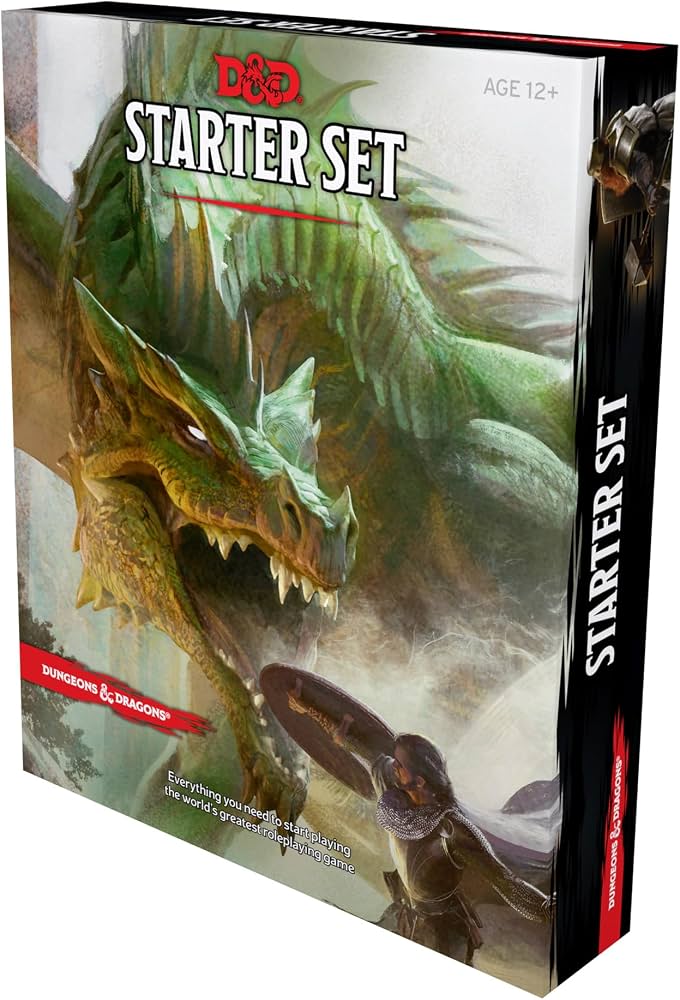
An introduction to the world’s most famous tabletop role-playing game, the D&D Starter Set offers new players an accessible way to experience fantasy adventure, create memorable characters, and discover the magic of collaborative storytelling.
Dungeons & Dragons has been inviting players into worlds of fantasy, mystery, and danger for decades. Yet for someone who has never played a tabletop role-playing game, the prospect of getting started can seem intimidating. Rulebooks are extensive, character creation involves unfamiliar terminology, and experienced players sometimes make the game look more complicated than it really is.
This is precisely where the D&D Starter Set comes in.
Designed as an introduction to Dungeons & Dragons, the Starter Set provides the essential materials needed to begin playing without requiring newcomers to purchase an entire collection of books. It introduces the basic rules, offers ready-made characters or character creation guidance depending on the edition, and provides an introductory adventure that teaches players how the game works through actual play.
But is it worth buying? What does it contain? Is it suitable for complete beginners, and can experienced players also find something useful inside?
Let's take a closer look at one of the most recognizable entry points into the world of tabletop role-playing games.
1. What Is the D&D Starter Set?
The D&D Starter Set is a beginner-oriented product published by Wizards of the Coast. Its primary purpose is straightforward: make it possible for a group of people to begin playing Dungeons & Dragons without first studying several large rulebooks.
Unlike a standard D&D campaign, which may require the Dungeon Master to prepare adventures, understand numerous rules, and help players build characters, a Starter Set provides a more structured introduction.
A typical set includes several essential components:
An introductory rulebook explaining the fundamental mechanics of the game.
A prewritten adventure that provides a setting, story, locations, and challenges.
Character sheets containing the information needed to play.
Dice used to determine the outcomes of uncertain actions.
Pre-generated characters or other beginner-friendly character creation resources, depending on the product.
The exact contents vary between editions and releases. Dungeons & Dragons has had several Starter Sets over the years, and they do not all contain the same adventure or materials.
The important distinction is that a Starter Set is not simply a smaller version of the complete D&D experience. It is an educational product built around learning through play.
Rather than expecting newcomers to understand every mechanic immediately, it introduces the most important concepts gradually.
2. Different D&D Starter Sets: Which One Should You Choose?
There is more than one D&D Starter Set, and this is worth understanding before purchasing one.
Over the years, Wizards of the Coast has released several introductory products designed for different generations of the game.
Some of the best-known examples include:
D&D Starter Set (2014)
<em>The Lost Mine of Phandelver</em> became one of the most recognizable introductory adventures in modern Dungeons & Dragons.
The original 2014 Starter Set introduced players to the fifth edition of D&D. Its adventure takes place in the Forgotten Realms and follows a group of adventurers drawn into a mystery involving a missing expedition, a dangerous criminal organization, and an ancient underground location.
Its greatest strength is its structure. The adventure begins with relatively straightforward encounters and gradually introduces more complicated situations.
For many players, it became their first experience of Dungeons & Dragons.
D&D Essentials Kit (2019)
The Essentials Kit offered another approach to introducing players to fifth edition.
Its adventure, <em>Dragon of Icespire Peak</em>, focuses on a region threatened by a dragon. Instead of following one tightly structured storyline, it offers a series of quests that can be approached in different ways.
This makes it particularly interesting for groups that want to experience a little more freedom from the beginning.
The Essentials Kit also introduced tools intended to support smaller groups, including guidance for playing with fewer participants.
D&D Starter Set: Dragons of Stormwreck Isle (2022)
<em>Dragons of Stormwreck Isle</em> is another beginner-friendly introduction to fifth edition.
The adventure takes place on a mysterious island shaped by the presence of dragons and ancient conflicts. Its relatively compact structure makes it suitable for groups that want to experience a complete introductory adventure without committing to a lengthy campaign.
It introduces exploration, combat, role-playing, and the atmosphere of the Forgotten Realms in a manageable format.
The 2024 D&D Starter Set
The 2024 revision of Dungeons & Dragons brought updated core rules and a new generation of introductory materials.
When choosing a Starter Set, it is important to check which rules revision it supports. Older products remain playable, but their terminology, character options, and mechanical details may differ from the revised rules.
For a new group, the most convenient choice is usually a set that matches the rulebooks and materials the group intends to use.
3. What Do You Actually Need to Play?
One of the most appealing things about the D&D Starter Set is how little equipment is required.
At its core, Dungeons & Dragons is a conversation supported by rules and dice.
You do not need an expensive gaming table, detailed miniatures, elaborate terrain, or a large collection of accessories.
The essential requirements are simple:
A Dungeon Master. One participant takes responsibility for describing the world, presenting challenges, portraying non-player characters, and interpreting the rules.
Players. Everyone else controls a character who participates in the adventure. A group of three to five players is a comfortable starting point, although different group sizes can work.
Character sheets. These record the abilities, skills, equipment, and other important details of each adventurer.
Dice. D&D uses several types of polyhedral dice. The most important is the twenty-sided die, commonly called a d20.
An adventure. The Starter Set provides one, so the group does not need to invent an entire fantasy campaign before beginning.
A quiet room and a little imagination are more than enough to get started.
The simplicity of these requirements is worth remembering. D&D is fundamentally a social activity, not a competition to own the most impressive collection of gaming accessories.
4. Understanding the Basic Rules
New players often assume that Dungeons & Dragons requires memorizing hundreds of rules.
In practice, the basic gameplay loop is much simpler.
The Dungeon Master describes a situation. A player explains what their character wants to do. If the outcome is uncertain, the Dungeon Master may ask for a dice roll.
The result is determined by combining the roll with relevant character abilities and modifiers.
For example, imagine that a character wants to climb a ruined tower.
The Dungeon Master describes the unstable stonework and asks for an ability check. The player rolls a d20 and adds the appropriate modifier.
A high result may mean the character reaches the top safely. A lower result may introduce a complication.
This basic principle supports an enormous variety of situations.
Players can investigate suspicious rooms, negotiate with merchants, explore abandoned temples, search for hidden passages, or attempt unusual solutions to problems.
The dice do not replace imagination. They introduce uncertainty into the shared story.
The Three Pillars of D&D
Most D&D adventures involve three broad types of activity:
Exploration: Discovering locations, investigating mysteries, navigating dangerous environments, and finding hidden information.
Social interaction: Speaking with other characters, negotiating, gathering information, and making decisions.
Combat: Facing opponents through a structured system of turns, movement, abilities, and dice rolls.
A good adventure balances these elements.
A campaign consisting entirely of combat can quickly become repetitive. Likewise, an adventure based exclusively on conversations may not satisfy players who enjoy tactical challenges.
The Starter Set gives newcomers an opportunity to experience different aspects of the game and discover what they enjoy most.
5. Pre-Generated Characters: A Shortcut Worth Taking
Character creation is one of the most enjoyable parts of Dungeons & Dragons.
Players can imagine warriors, wizards, rogues, clerics, and countless other fantasy archetypes. They can develop personalities, histories, motivations, and personal goals.
However, character creation can also be overwhelming for someone who has never played before.
This is why pre-generated characters are such a useful feature of introductory products.
Instead of spending the first session comparing abilities and studying character options, players can choose an existing character and begin the adventure almost immediately.
This approach has several advantages.
First, it allows newcomers to learn the rules through actual gameplay rather than theoretical preparation.
Second, it helps the Dungeon Master introduce the game without having to explain every character-building decision.
Finally, it gives players an opportunity to discover which playstyles they enjoy before creating more personalized characters.
There is nothing wrong with beginning with a ready-made hero. Experienced role-players sometimes forget that learning the fundamentals is more important than making every character choice perfectly.
Once the group understands the system, creating original characters becomes much easier.
6. The Dungeon Master: Learning to Run Your First Adventure
The Dungeon Master has a special role in Dungeons & Dragons.
Unlike players, who generally control one character, the Dungeon Master is responsible for presenting the world and responding to the decisions made by the group.
This can sound intimidating, especially for someone who has never run a tabletop RPG.
Fortunately, a Starter Set provides a structured adventure that reduces much of the preparation required.
It usually includes descriptions of locations, important characters, encounters, and information about how different situations can develop.
The Dungeon Master does not need to memorize everything.
A better approach is to read the relevant sections before the session, understand the important events, and keep the necessary information nearby.
There is also an important principle worth remembering:
The Dungeon Master is not an opponent of the players.
The purpose of the game is not to defeat the adventurers or prove that the world is impossible to survive. The goal is to create interesting situations and help the group tell a compelling story.
Mistakes are inevitable during a first session. Rules will be forgotten, unexpected questions will appear, and certain encounters may take longer than anticipated.
That is perfectly normal.
A confident Dungeon Master is not someone who knows every rule by heart. It is someone who can maintain the flow of the game, make reasonable decisions, and learn from experience.
7. Why the Starter Set Is Excellent for Beginners
The greatest strength of the D&D Starter Set is accessibility.
Many tabletop role-playing games require players to understand complex systems before they can fully enjoy them. Dungeons & Dragons can certainly become mechanically demanding, but its introductory products offer a gentler beginning.
There are several reasons why this approach works.
It reduces the initial investment. Players do not need to purchase several large rulebooks before discovering whether they enjoy the game.
It provides a ready-made adventure. The group can concentrate on playing instead of spending weeks designing a campaign.
It introduces rules gradually. New players learn through practical situations rather than trying to memorize an entire system.
It encourages cooperation. The adventure gives players reasons to communicate, share information, and work together.
It creates a common starting point. Everyone begins with the same basic understanding of the game, which makes the first session easier to manage.
Perhaps most importantly, the Starter Set removes the psychological barrier that often prevents people from trying tabletop RPGs.
You do not need to be an experienced fantasy enthusiast, a talented actor, or an expert in mathematics.
You simply need curiosity and a willingness to participate.
8. Is the D&D Starter Set Suitable for Experienced Players?
Although introductory products are primarily designed for newcomers, experienced players should not dismiss them automatically.
A Starter Set can be useful when introducing friends or family members to Dungeons & Dragons.
It can also serve as a convenient foundation for a new group that wants to begin playing without extensive preparation.
Some introductory adventures contain locations, characters, and encounters that can be adapted for other campaigns.
The structure of a beginner adventure can also be an educational resource for Dungeon Masters.
It demonstrates how to introduce a setting, establish a central problem, present challenges, and gradually expand the scope of an adventure.
For experienced players, the most valuable lesson may be the importance of simplicity.
A memorable campaign does not necessarily require an enormous setting, dozens of factions, or complicated political structures.
Sometimes a small village, an interesting mystery, and a handful of memorable characters are enough to create an excellent adventure.
9. Limitations: What the Starter Set Does Not Provide
Despite its advantages, the D&D Starter Set is not a complete replacement for the core rulebooks.
Its purpose is to introduce the game, not provide every option available in the wider system.
Depending on the edition, players may encounter limitations involving:
Available character classes and species.
Character advancement options.
Spell selection.
Equipment and magic items.
Detailed rules and optional mechanics.
Guidance for designing extensive campaigns.
These limitations are intentional.
A beginner's product needs to remain manageable. Including every possible option would undermine its main purpose.
There is also a difference between completing an introductory adventure and understanding everything Dungeons & Dragons can offer.
After finishing the adventure, a group may want to explore additional settings, create original characters, experiment with different campaign styles, or introduce more advanced rules.
That is the natural next step.
The Starter Set should be viewed as a beginning rather than a final destination.
10. What Should You Buy After the Starter Set?
Once the group has completed its introductory adventure, the next purchase depends on what everyone wants from the game.
For groups interested in continuing with the same edition, the most useful additions are generally the core rulebooks.
The Player's Handbook provides expanded character creation options, rules for abilities, equipment, spells, and other essential player-facing information.
The Dungeon Master's Guide offers advice and resources for running campaigns, designing adventures, managing rewards, and building fictional worlds.
The Monster Manual provides a collection of creatures and opponents that Dungeon Masters can use when preparing encounters.
There is no need to purchase everything immediately.
A group that enjoys the game can gradually expand its collection. Some players may prefer additional adventures, while others may be more interested in settings, miniatures, maps, or digital tools.
The best approach is to identify what the group actually needs rather than buying products simply because they exist.
11. The Starter Set as an Introduction to the Spirit of Role-Playing
There is something particularly valuable about beginning Dungeons & Dragons with a simple introductory adventure.
Modern entertainment often encourages passive consumption. Players watch stories unfold, follow predetermined narratives, or interact with systems designed around specific objectives.
Tabletop role-playing games offer something different.
They invite participants to become active contributors to a shared fictional world.
A seemingly ordinary decision can change the direction of an adventure. An unexpected conversation may become more memorable than a carefully prepared encounter. A failed dice roll can create a new problem that the entire group must solve.
This is one of the fundamental attractions of tabletop RPGs: the story is not entirely written in advance.
The Starter Set introduces this philosophy in a relatively controlled environment.
New players discover that there is no single correct way to approach every situation. The rules provide structure, but imagination determines how that structure is used.
It also introduces an important social dimension.
D&D is a cooperative experience built around communication, trust, and shared creativity. Players learn to respect one another's ideas, accept unexpected developments, and contribute to a story that belongs to the entire group.
That experience can be far more rewarding than simply completing another game.
Conclusion: Is the D&D Starter Set Worth It?
For anyone interested in discovering Dungeons & Dragons, the Starter Set is one of the most practical ways to begin.
It offers the essential materials needed for an introductory adventure, reduces the complexity of learning the rules, and provides a structured experience for both players and Dungeon Masters.
Its greatest achievement is not the amount of content included in the box. It is the fact that it makes the first step into tabletop role-playing considerably easier.
Of course, it has limitations. It does not provide the full range of character options, rules, or resources available in the complete game. Experienced groups will eventually want to explore additional materials.
But that is exactly what an introductory product should encourage.
The D&D Starter Set is an invitation to discover a hobby built around imagination, cooperation, and shared adventures. It gives newcomers the opportunity to experience the fundamentals before deciding how deeply they want to explore the hobby.
You do not need an enormous collection of books, expensive accessories, or years of experience to begin.
You need a few people, some dice, an adventure, and the willingness to imagine what happens next.
Sometimes, that is all it takes to begin a legendary campaign.