Build Your World Like Gygax: The 1975 Method in Practice
Start a playable campaign with a premise, a small region, a dungeon, and a town. Then let the players show you what needs building next.
A campaign world becomes useful when players can make decisions inside it. A ferry that has stopped running, a mine with a second entrance, and a town willing to pay for help can support a session long before you have named every kingdom.
That is the practical value of returning to Gary Gygax’s 1975 campaign advice: it gives you a way to begin with the material play will actually touch. Below, historical context is followed by an original worked example you can adapt to your own game.
What Gygax actually proposed in 1975
Gygax’s article appeared in Europa issues 6–8 in April 1975. Its title begins “How to Set Up Your Dungeons & Dragons Campaign.” It discusses five areas: the campaign’s premise, the surrounding countryside, a central dungeon, a nearby large town, and eventual expansion into the wider world.
The article allows a campaign to start before that world is complete. Its immediately necessary material can be prepared first, with further development continuing as the game grows. That is different from demanding a finished setting before session one.
The original article and the Gygax 75 Challenge
Ray Otus’s Gygax 75 Challenge turns this earlier advice into a later workbook with a weekly structure. The familiar five-week challenge is Otus’s adaptation, not a timetable prescribed by Gygax in the original article.
Choose the workbook if a schedule helps you finish. Choose a shorter preparation session if you already have players waiting. The example below is justroll’s own application of the small-starting-area idea; its specific factions, locations, and checklist are not historical instructions from Gygax.
Step 1: write a premise that creates decisions
Our example: the spring floods have opened a sealed silver mine beside the town of Reedbank. At night, a bell rings underground. The ferrymaster wants the road made safe, a miners’ family wants a missing relative returned, and a collector wants an object recovered without witnesses.
This premise gives the party several reasons to act without deciding how the adventure must end. It also provides a test for new ideas: will this detail help the players choose a destination, understand a danger, or deal with another person? If not, it can probably wait.
The local problem: travelers have stopped using the ford after dark.
The visible opportunity: newly exposed workings may still contain valuable tools and ore.
The complication: someone is buying supplies for a second expedition.
The open question: why does a bell ring when there is no bell tower underground?
Keep cosmology and ancient history as short notes until they affect an immediate decision. You can establish that the mine predates the town without writing the biography of every person who once owned it.
Step 2: map an area the party can actually cross
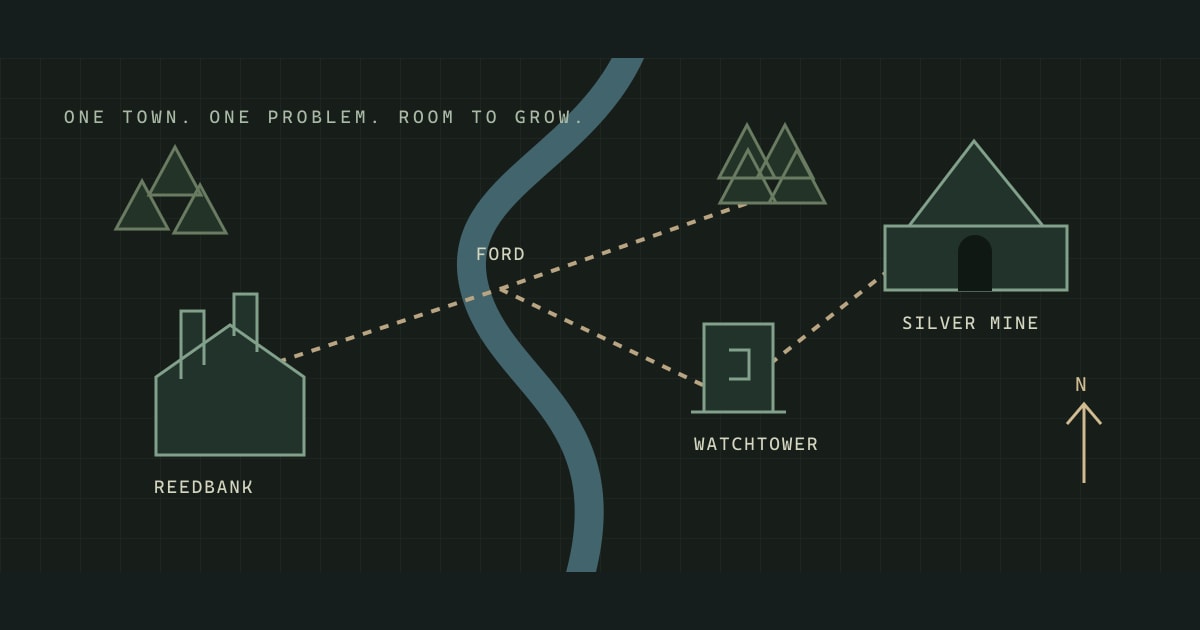
Draw Reedbank, the mine, a ford, a wooded ridge, and a ruined watchtower. Add two roads and one slower route along the river. Measure travel using your chosen game’s rules; the important preparation is the difference between routes, not a universal number of miles.
Route | What the players know | What makes it a decision |
|---|---|---|
Road to the mine | Fast and easy to follow; recent wagon tracks. | The rival expedition can watch it. |
Riverbank path | Mud, reeds, and a narrow side entrance above the water. | Slower travel may avoid the occupied main gate. |
Ridge trail | A view over the ford and the mine road. | Useful information costs daylight and climbing effort. |
Leave one edge of the map unfinished. A marked road heading toward a larger settlement is enough to promise a wider world. You can decide what lies there when the party has a reason to travel it.
Step 3: prepare a dungeon with choices
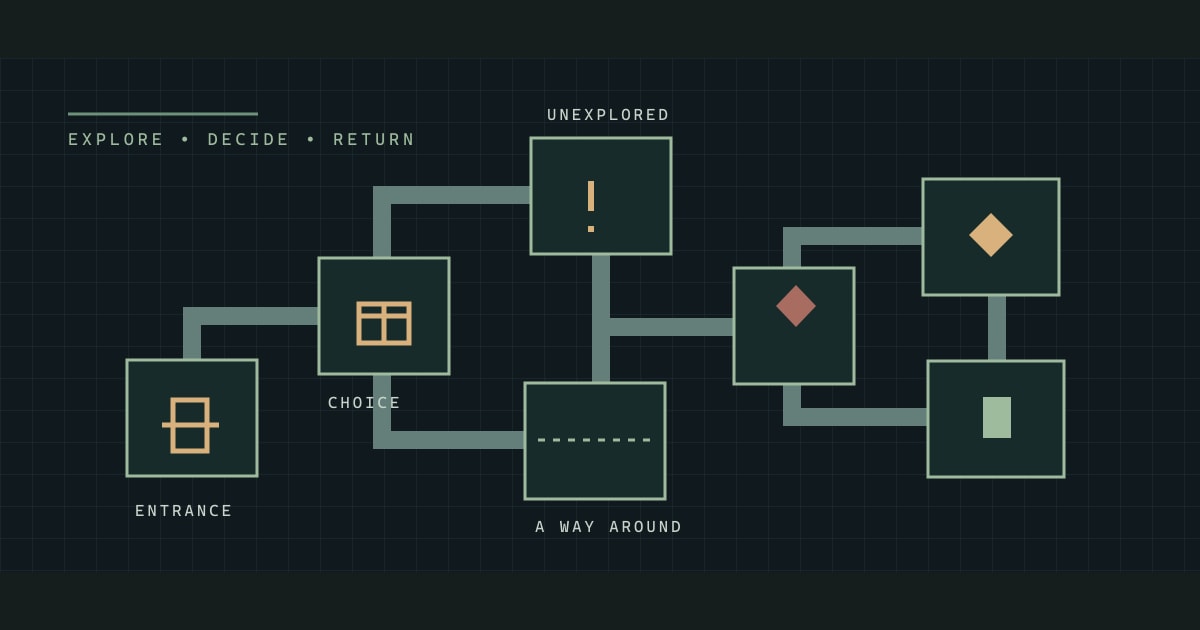
For a first session, key six locations rather than writing six pages of background. Give the mine a main entrance, a flooded side opening, and an internal loop. Players who discover the loop can change their route instead of marching through a fixed sequence.
The gatehouse: occupied by two exhausted prospectors who want food and a way out.
The tally room: old records identify a sealed lower gallery and a missing shift.
The pump chamber: water can be redirected, changing which passage is accessible.
The flooded stairs: floating timber suggests something large recently moved below.
The bell gallery: a suspended metal plate sounds when air rushes through a cracked shaft.
The locked store: valuables and evidence of a recent visitor, with another way back to the gatehouse.
These are seeds, not a complete keyed adventure. Before play, add concrete dimensions where they matter, visible clues, the consequences of interfering with machinery, and whatever statistics your chosen game requires. Put information about a hazard where the party can discover it before committing.
Give inhabitants needs instead of scripts
The prospectors want to leave but fear losing their claim. A creature below wants quiet and an open water passage. The rival expedition wants the store’s contents and prefers a bargain to an expensive fight. Those motives let you answer unexpected actions without deciding that every room must become combat.
Step 4: make the town support the expedition
Reedbank needs places to obtain information, recover, and spend resources. Begin with a lodging house, a supplier, a ferry office, and a meeting place. A memorable person at each location is more useful than a census.
Mara, the ferrymaster, pays for evidence that the ford is safe; she cannot promise unlimited coin.
Old Bren, the supplier, can replace ordinary equipment but wants a deposit for scarce rope.
Tessa, whose brother is missing, recognizes his distinctive tally marks.
The collector offers more money than Mara and refuses to explain why the object matters.
These are original fictional characters for the example. Their competing interests turn the return journey into play: whom does the party believe, what evidence do they share, and what are they willing to sell?
Step 5: expand from consequences
After the session, write down what changed. If the party redirected the water, who lost access? If they negotiated with the rival expedition, what did each side promise? If they recovered the store’s records, who would care about them outside Reedbank?
Develop the next location that those answers make relevant. A ruined watchtower can become a rival camp, a safe route, or the site of an unanswered signal. You have a reason to prepare it now, and that preparation responds to choices the players remember.
A first-session preparation checklist
One clear problem, three leads, and more than one reason to investigate.
A readable local map with routes that differ in risk, time, or information.
A keyed location with warnings, discoveries, inhabitants, and an alternate entrance.
The rules and statistics you need, kept separate from background prose.
A town with recovery, supplies, information, and people who disagree.
A blank page for consequences and questions raised during play.
If preparation stalls, ask what the players could do in the first fifteen minutes. Answering that question usually exposes the missing piece: an obvious lead, a description of the entrance, or a person who can respond to them.
Where to go next
Our introduction to OSR play explains why visible information and alternate routes matter. For three different ways an adventure can organize its challenges, read Tomb of Horrors, Ravenloft, and Queen of the Spiders. Neither approach requires the Reedbank example to have a predetermined ending.
Historical sources
Europa 6–8, April 1975: original magazine scan — Gygax’s original article.
Ray Otus: The Gygax 75 Challenge — the later creator-authored workbook and its relationship to the earlier advice.