What Is OSR RPG? Old-School Play Explained at the Table
What Old School Renaissance means, how an OSR session works, and how to try its approach to exploration, danger, and player choice.
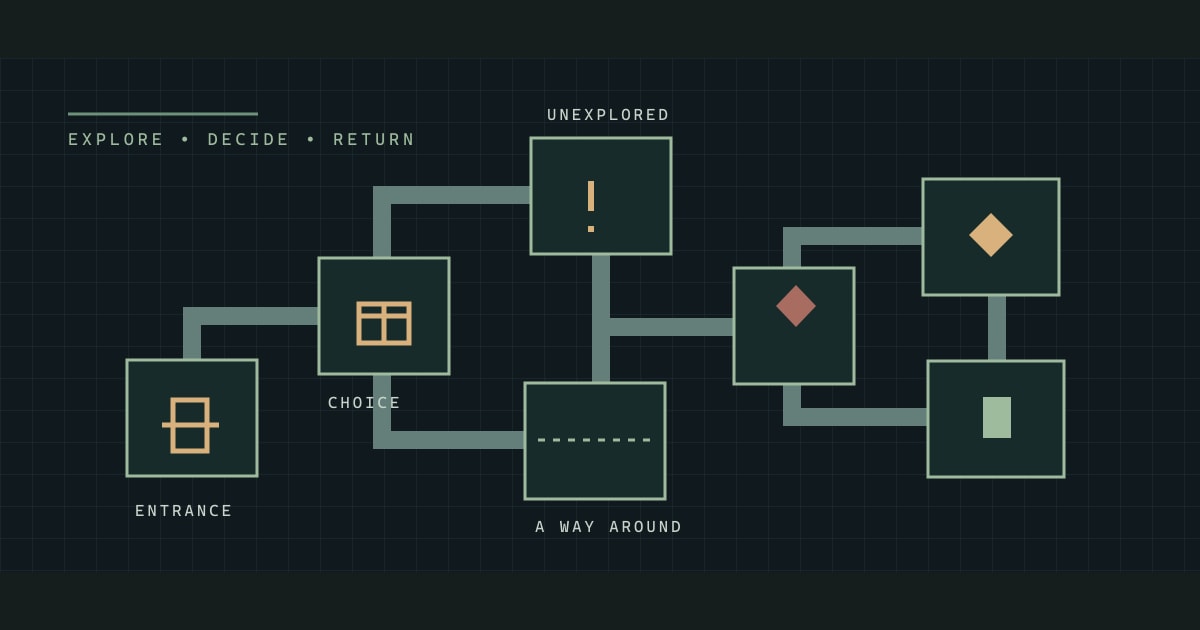
OSR usually stands for Old School Renaissance or Old School Revival. It describes a movement in tabletop role-playing games and a family of approaches to play inspired by early fantasy RPGs. An OSR game often asks players to explore a dangerous place, gather information, manage limited resources, and decide which risks are worth taking.
OSR is not the name of one universal rules system. Two games carrying that label can have different character rules, combat procedures, and assumptions about the world. The useful question is what the group actually does during a session.
OSR and Old-School Essentials are different things
Old-School Essentials, often abbreviated OSE, is a particular game published by Necrotic Gnome. Its Classic Fantasy rules draw on Basic/Expert D&D. OSR is the broader label; OSE is one game associated with it. Expanding OSR as “Old-School Essentials” confuses the movement with the product.
The distinction matters when choosing rules. Someone who enjoys a familiar early-D&D structure may want a retroclone. Someone who wants a smaller toolkit may prefer a game that changes that structure while keeping exploration central. The label alone does not tell you how many pages you need to read.
What happens in an OSR session?
Imagine a party standing outside a flooded shrine. There are fresh bootprints at the entrance, smoke rising through a crack in the roof, and a warning carved into a stone. The characters have enough light for a short expedition. Their objective is to recover a silver reliquary, not to defeat everything inside.
The players can investigate the tracks, watch the roof, question a local guide, or enter immediately. Each choice changes what they know and which risks they face. A satisfying session can end with the party retrieving the reliquary through negotiation and leaving a powerful creature undisturbed.
Information makes decisions meaningful: describe the acidic smell before someone touches the pool.
Resources give exploration a cost: time, light, carrying space, spells, or the willingness of hired help.
The place continues to exist beyond the party: its inhabitants have motives and can react.
Retreat is a real option: an expedition can reveal useful information even when it brings home little treasure.
Player ingenuity and character abilities
A common old-school preference is to let a concrete plan change the situation before asking for a roll. Suppose a corridor contains a pressure plate. A player wedges the plate with a steel spike, then tests it from behind cover. That description gives the referee something specific to adjudicate.
This does not require abolishing ability checks or making players act out every conversation. A roll remains useful when an outcome is uncertain and its consequences matter. The point is to establish what the character attempts, what information is available, and what success would accomplish.
An example of a useful ruling
In our shrine, a rope bridge hangs over fast water. The referee says it can hold one unarmored person but will probably fail under the whole party. The players can remove equipment, secure another line, look for a ford, or accept the risk. Everyone can understand the problem before a die is rolled.
If a ruling introduces a new risk, explain it before the player commits. Record decisions that will recur. “Rulings over rules” works better when similar actions receive similar treatment and the group can discuss a disputed call.
Danger needs warning and room for choice
Low durability can make an adventure tense, but surprise punishment is not the only way to create danger. A chamber full of cracked bones, corroded metal, and a sleeping shape tells a different story from an empty room that kills a character without warning.
For your own dungeon, prepare three pieces of information for a major hazard: an observable warning, a way to investigate, and at least one possible route around it. You do not need to invent the party’s solution. You do need to give them enough material to make one.
Tell the group how dangerous the game is intended to be. Agree on replacement characters, how retreat works, and whether the campaign rewards recovered treasure, exploration, or some other goal. Those expectations matter more than proving that a game is sufficiently old-school.
OSR compared with D&D 5e
These are tendencies a group might choose, not rules that every OSR or D&D table follows. You can run exploration-focused D&D 5e, and you can run an OSR game with a strong continuing story.
Question | An exploration-focused OSR approach | A common D&D 5e approach |
|---|---|---|
What defines the challenge? | A location with opportunities and dangers the party can investigate. | Encounters and objectives built around the party’s capabilities. |
What makes a good solution? | A workable plan, including bypassing the obstacle. | Character abilities combined with player decisions and teamwork. |
What does a fight mean? | One possible tool, sometimes an expensive mistake. | Often a substantial part of the expected adventure. |
What drives the next session? | Consequences of exploration and the players’ chosen destination. | A mix of prepared story, character goals, and open choices. |
Avoid importing only the danger into a game whose other rules promise something different. If players built durable heroes for a heroic campaign, discuss a change in tone rather than quietly removing the assumptions their characters depend on.
Two starting points to investigate
Old-School Essentials is worth investigating if you want a structured presentation of classic fantasy procedures. Knave offers a different entry: a compact, classless toolkit in which equipment helps shape a character’s role. Check which edition you are considering; a game’s first and second editions can differ substantially.
Use the publisher’s material to check what is included before buying anything. Your practical comparison should cover character creation, how exploration time is tracked, how encounters begin, and how the referee handles an uncertain action. An attractive cover cannot answer those questions for your group.
Try the approach in one evening
Choose one small location with two entrances, a loop, a secret, and inhabitants who want different things.
Give the party a specific objective and a reason to return alive.
Make the immediate hazards observable, and provide clues to the less obvious ones.
Use your chosen rules consistently for light, time, encounters, and recovery.
After play, ask which decisions felt informed, where a ruling was unclear, and whether the players had a believable chance to withdraw.
Keep the first location small enough that you can respond to an unexpected route. You will learn more from the players discovering a second entrance than from preparing a continent they never visit.
Build something to explore
For a practical next step, use our guide to Gygax’s 1975 campaign-building approach to make a small starting area. If you are playing alone, try the original card-based solo dungeon crawl and pay attention to the moment when returning home becomes more attractive than opening another door.
Sources and further reading
Necrotic Gnome: About Old-School Essentials — publisher description and the distinction between its rules lines.
Questing Beast: Knave — the creator’s description of the original game.
The shrine, bridge, and preparation exercise above are original justroll examples. They illustrate possible table practices rather than prescribing one official OSR ruleset.