How to Play a Solo Dungeon Crawl with a Deck of Cards
A complete original game for one player: explore rooms, risk your supplies, recover treasure, and decide when to return to the surface.
You can play a small dungeon expedition with one ordinary deck of cards, paper, and a pencil. The cards provide rooms and uncertain outcomes. Your decisions determine how much you risk before trying to escape.
The rules below are an original justroll microgame. They are system-neutral and use their own vitality and supply values. They are not official D&D rules or a conversion of a published solo RPG. No dice, app, or additional book is required.
Set up the expedition
Use a standard 52-card deck. Remove both jokers, shuffle once, and place it face down. Do not reshuffle during the expedition.
Write down vitality 6, supplies 3, and treasure 0. Vitality cannot exceed 6; supplies cannot exceed 3.
Choose a reason for entering the dungeon: buying a relative’s freedom, recovering a lost inheritance, or funding a journey.
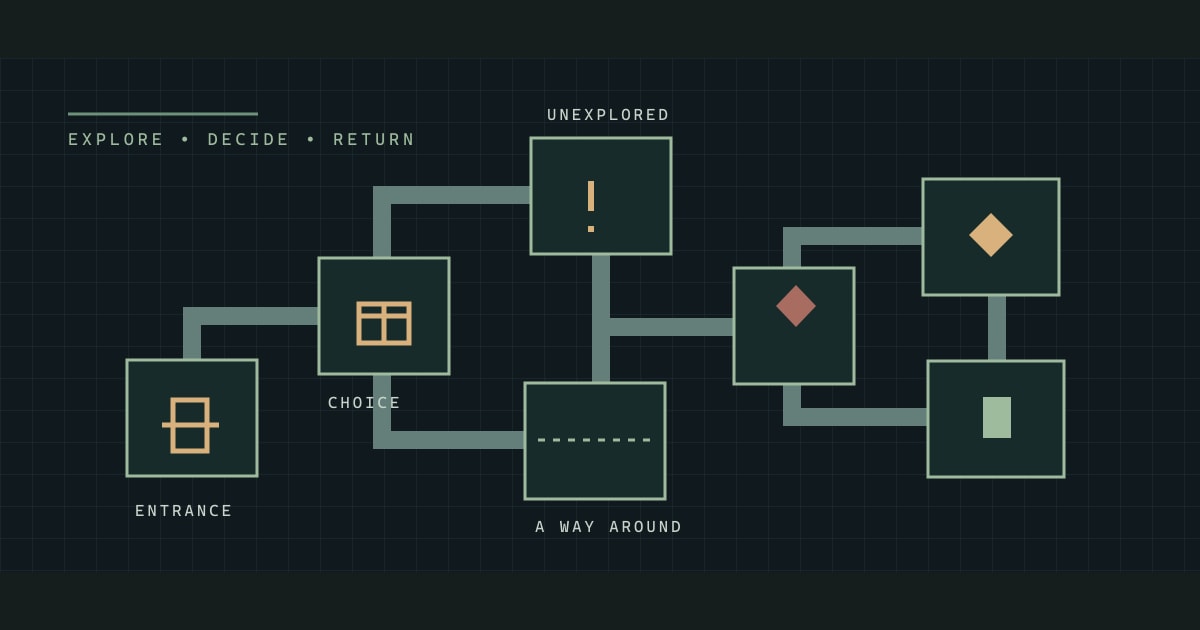
Draw a small entrance on your paper. Leave space for rooms and a discard pile.
Your goal is to return alive with at least 4 treasure. Returning alive with less is a safe but incomplete expedition. Reaching 0 vitality means you are lost in the dungeon and keep no treasure. Each treasure is an abstract valuable find, not a fixed number of gold pieces.
Explore one room at a time
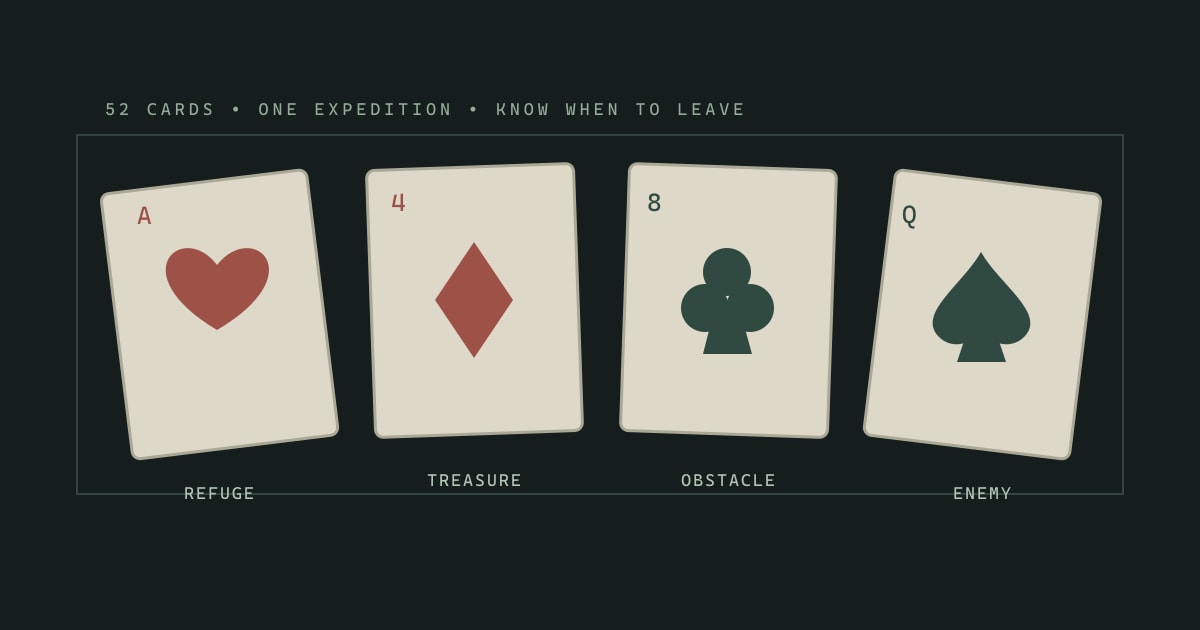
At the start of each turn, choose either to explore or to leave. To explore, draw the top card as a room card, place it in the discard pile, and resolve its suit using the table below. Draw a room on your map and connect it to the previous one. You do not resolve old rooms again.
Room suit | What you find | Choose and resolve |
|---|---|---|
Hearts — refuge | A place to catch your breath or recover equipment. | Restore 2 vitality OR gain 1 supply, up to the usual maximums. No check. |
Diamonds — treasure | A portable valuable you can recover safely. | Gain 1 treasure. No check. |
Clubs — obstacle | A barrier, trap, or unstable passage. | Spend 1 supply to bypass it automatically, OR make a check. Failure costs 1 vitality; success costs nothing. |
Spades — enemy | Something that blocks your progress. | Spend 1 supply to evade it automatically, gaining no treasure, OR fight by making a check. A successful fight gains 1 treasure; a failed fight costs 2 vitality. |
Resolve only the drawn suit. You cannot take both rewards from a refuge, and evading an enemy does not also grant its treasure. You may explore again after the room is resolved, as long as you remain alive and cards remain.
How a check works
A check consumes the next card from the same deck. It is a check card, not a new room: ignore its suit and discard it after reading its value. An ace is 1, number cards use their printed number, a jack is 11, a queen 12, and a king 13.
A check succeeds on a value of 7 or more. Before drawing, you may spend 1 supply to add 3 to that check. You cannot spend after seeing the card, and you cannot spend more than 1 supply on a single check. Without a boost, 7–king succeeds; with a boost, 4–king succeeds.
If no card remains when a check is required, the check fails automatically and you spend no supply on a boost. A failed check uses the consequence of the room or exit that required it. Stop immediately if a consequence reduces vitality to 0.
Bypass or boost?
At an obstacle, paying 1 supply to bypass is safer than paying the same supply to boost a check. The gamble is attempting the check without spending, so you can keep supplies for later. Against an enemy, boosting a fight can be worthwhile because a successful fight earns treasure; evasion keeps you safe but earns nothing.
Leaving the dungeon
You may choose to leave instead of drawing another room. Make one exit check, using the same values and optional supply boost. On success, you return with your current treasure. On failure, lose 2 vitality and 1 treasure, to a minimum treasure of 0; if you survive, you still reach the surface with what remains.
That is the end of the expedition. You cannot return to exploration after an exit check, even after a failure. If the room deck is empty at the start of your turn, you must leave. With no card to draw, the exit check fails automatically and applies the same losses.
To win, you must be alive at the surface with at least 4 treasure after resolving the exit. Having 4 treasure underground is not yet a win. Leaving with 5 provides a buffer against a lost treasure, but continuing to search can also cost the vitality you need to survive the return.
Give the rooms a character
The room card’s value can inspire a description without changing its mechanical effect. Use the following prompts as suggestions, not additional rewards or penalties. This keeps fictional details from silently changing the difficulty.
Room value | Possible detail | A question to answer on the map |
|---|---|---|
Ace–4 | Old masonry, dry dust, cramped passages. | Who built this, and what did they leave behind? |
5–9 | Water, roots, collapsed walls, recent footprints. | What has changed since this place was abandoned? |
10–king | Ceremonial spaces, unusual machinery, signs of an occupant. | What makes this part of the dungeon important? |
A heart might be a warm guardroom or a pocket of clean air. A club might be a broken bridge or a door jammed by roots. A spade can represent a hostile creature, a patrolling construct, or an argument with a suspicious guardian. Use “fight” as the mechanical label even if your fiction describes a contest rather than violence.
A worked expedition
Begin at vitality 6, supplies 3, treasure 0. Your first room is the 3 of diamonds: gain 1 treasure. You describe coins inside a cracked pottery jar. The next room is the 8 of clubs, a flooded passage. You attempt it without supplies; the check card is a 5. Discard that 5 without resolving its suit and lose 1 vitality. You now have vitality 5.
Next comes a queen of spades. You fight and spend 1 supply before drawing. A 4 becomes 7 with the boost, so the fight succeeds and treasure rises to 2. Your supplies are now 2. A heart in the following room restores vitality to 6. You have used a room card for each location and an extra card for each check.
Later, suppose you have vitality 3, supplies 1, and treasure 4. You choose to leave and spend your last supply. A drawn 3 becomes 6, so the exit fails: vitality drops to 1 and treasure to 3. You survive but miss the goal. If that check card had been a 4, you would have returned with all 4 treasure and won.
Common rules questions
Do check cards create additional rooms?
No. Their suit is ignored. This is why the deck becomes shorter when you take risks, even if you are not adding as many rooms to your map.
Can I rest repeatedly in a heart room?
No. Resolve each room once when it is drawn. A heart gives one choice between healing and supplies, then goes into the discard pile.
What happens if I reach the final card?
Resolve it normally as a room. If it needs a check and the deck is now empty, that check fails. If you survive, leaving becomes mandatory on the next turn and the empty-deck exit check also fails. A heart or diamond on the final card does not cancel the exit.
After the expedition
Keep the map and write three sentences: what you wanted, what you found, and why you chose to leave. For another independent expedition, reset all three resources and shuffle a complete deck. You can revisit the same fictional dungeon, but do not carry treasure or supplies into the next game unless you deliberately design a separate campaign variant.
For group play, the card prompts can inspire locations, but use your group’s chosen rules to resolve them. Our OSR guide discusses informed risk and retreat, while the campaign-building example shows how to turn a small location into part of a continuing world.
The original rules, prompts, and example in this article were checked against a small automated rules model, including empty-deck endings and supply use. That checks the procedure; it does not replace trying the game with your own preferred level of risk.