Dungeons & Dragons Player’s Handbook
Dungeons & Dragons Player’s Handbook
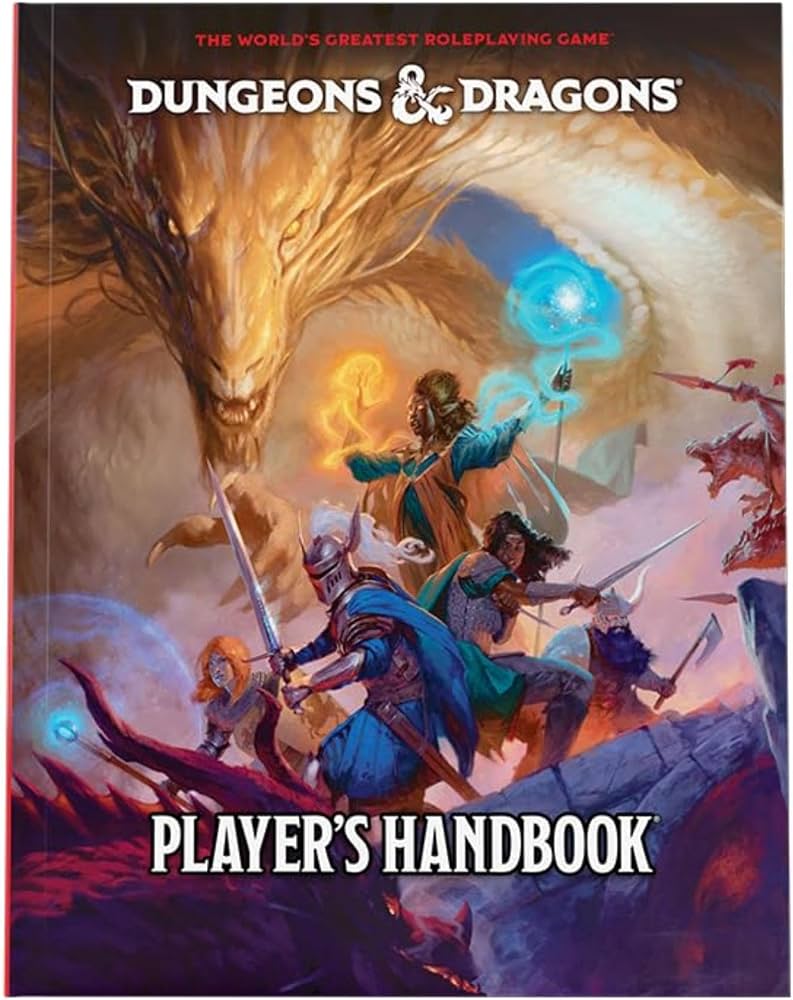
More than a rulebook, the Player’s Handbook is the gateway to fantasy roleplaying. Discover what it contains, how it shapes the player experience, and why it remains one of the most important books in tabletop RPG history.
Introduction: The Book That Opens the Door to Adventure
Every great tabletop roleplaying adventure begins with imagination. A mysterious castle stands beyond the mountains. An ancient dragon guards a forgotten treasure. A group of unlikely heroes gathers in a tavern, unaware that their decisions will eventually shape the fate of entire kingdoms.
But imagination alone does not provide a shared structure for a roleplaying game. Players need rules, characters need abilities, and the group needs a common understanding of how its fictional world operates.
This is where the Dungeons & Dragons Player’s Handbook comes in.
For decades, the Player’s Handbook has been one of the defining books of the tabletop RPG hobby. It provides the fundamental rules players need to create characters, understand their abilities, participate in adventures, and interact with the worlds created by their Dungeon Masters.
Yet its importance goes beyond mechanics. For many people, opening a Player’s Handbook is the first step into a hobby that combines storytelling, strategic thinking, creativity, cooperation, and social interaction.
Whether you are completely new to Dungeons & Dragons or an experienced player returning to the game, understanding the purpose of the Player’s Handbook is essential.
1. What Is the D&D Player’s Handbook?
The Player’s Handbook, commonly abbreviated as PHB, is one of the core rulebooks of Dungeons & Dragons.
It is primarily written for players rather than Dungeon Masters. Its purpose is to explain how characters are created, how the basic rules work, and what players can do during an adventure.
Although individual editions differ in their presentation and mechanics, the fundamental purpose remains remarkably consistent.
The book answers several essential questions:
How do you create a character?
What abilities and skills can a character possess?
How does combat work?
What can characters do during exploration?
How does magic function?
How are difficult or uncertain actions resolved?
What happens when characters gain experience and become more powerful?
The Player’s Handbook also introduces the philosophy of Dungeons & Dragons. It explains that the game is a shared activity in which players describe what their characters attempt to do, while the Dungeon Master presents the world and determines how it responds.
This relationship between imagination and rules is the foundation of the entire experience.
A book for players, not just beginners
The Player’s Handbook is often associated with newcomers, but experienced players also rely on it.
Even veteran adventurers may need to check a spell description, review a character feature, clarify a condition, or confirm how a particular rule works.
It is both an introductory guide and a practical reference book.
2. Understanding the Different Editions
One important thing to understand is that there is no single universal Player’s Handbook.
Dungeons & Dragons has evolved through multiple editions, and each edition has introduced changes to its rules, character options, terminology, and overall design philosophy.
The Player’s Handbook reflects the specific edition for which it was written.
Some particularly influential versions include:
Advanced Dungeons & Dragons: Established many elements that shaped the traditional identity of the game.
Dungeons & Dragons Third Edition: Introduced a detailed and flexible rules framework that encouraged character customization.
Dungeons & Dragons Fourth Edition: Emphasized structured combat encounters, tactical positioning, and clearly defined character abilities.
Dungeons & Dragons Fifth Edition: Focused on accessibility, familiar fantasy conventions, and a relatively streamlined rules system.
The 2024 revised Fifth Edition rules: Updated the Fifth Edition experience through revised character options, class features, spells, and core procedures.
The 2014 and 2024 Fifth Edition Player’s Handbooks should not be treated as completely interchangeable. They share a common foundation, but some rules and character options differ.
For players purchasing a book, checking the edition is therefore important.
A group using the 2014 rules should generally agree before introducing material from the 2024 revision. Mixing editions without discussion can create confusion.
3. Character Creation: Building Your First Adventurer
For many players, character creation is the most exciting part of the Player’s Handbook.
It is the moment when a vague fantasy concept becomes a character with abilities, strengths, weaknesses, and a place in the world.
Dungeons & Dragons offers numerous possibilities. A player might create a wandering warrior, a mysterious spellcaster, a devoted healer, a clever explorer, or a charismatic performer.
The Player’s Handbook provides the mechanical framework for turning these ideas into playable characters.
Choosing a class
A character's class represents their broad adventuring specialization.
Depending on the edition, the available classes include familiar fantasy archetypes such as:
Barbarian: A powerful warrior whose abilities are associated with extraordinary physical determination.
Bard: A versatile adventurer who combines magic, knowledge, and performance.
Cleric: A character whose abilities are connected to divine or sacred power.
Druid: A practitioner of nature-related magic.
Fighter: A trained combatant with a broad range of martial capabilities.
Monk: A disciplined martial artist who draws on specialized training and personal discipline.
Paladin: A champion whose abilities are connected to sacred commitments and ideals.
Ranger: An experienced explorer and wilderness specialist.
Rogue: A resourceful character skilled in stealth, precision, and problem-solving.
Sorcerer: A spellcaster whose magic comes from an innate supernatural source.
Warlock: A character whose magical abilities are associated with a powerful otherworldly patron.
Wizard: A spellcaster who studies and develops magic through knowledge and practice.
Not every edition presents these classes in exactly the same way. Some have changed substantially over the years.
The important thing is to choose a class that supports the kind of character you want to play.
A class is not a personality. Two fighters can be completely different people. One might be a disciplined professional, while another could be a wandering idealist who avoids unnecessary conflict.
Choosing an origin and background
A character also needs a personal history.
Where did they come from? What did they do before becoming an adventurer? What motivates them to travel with other people?
Backgrounds help answer these questions.
A character might have been a scholar, artisan, soldier, entertainer, criminal, noble, or wandering traveler.
The background is not merely a collection of mechanical bonuses. It gives the player a starting point for creating a believable individual.
A well-developed character should have reasons to participate in the adventure beyond simply gaining experience points.
4. Ability Scores: Understanding What Your Character Can Do
One of the most recognizable elements of Dungeons & Dragons is its six ability scores.
They represent broad aspects of a character's capabilities.
Ability | What It Represents |
|---|---|
Strength | Physical power and exertion |
Dexterity | Agility, coordination, and reflexes |
Constitution | Physical resilience and endurance |
Intelligence | Reasoning, memory, and knowledge |
Wisdom | Awareness, intuition, and judgement |
Charisma | Confidence, influence, and personal presence |
These abilities influence many aspects of gameplay.
A character with high Intelligence may be particularly effective at recalling information and understanding complicated subjects. High Wisdom can help with perception and awareness. Charisma is important for characters who rely on persuasion, performance, or social influence.
However, ability scores should not dictate personality.
A character with low Charisma does not have to be unpleasant or incapable of meaningful relationships. A character with high Intelligence does not automatically need to be a stereotypical academic.
The numbers describe mechanical capabilities. The player decides who the character actually is.
5. Skills and Proficiencies: Giving Characters Individual Strengths
Ability scores establish broad capabilities, but skills help define what characters have learned to do.
Depending on the edition, skills may cover activities such as:
Acrobatics
Animal Handling
Arcana
Athletics
Deception
History
Insight
Investigation
Medicine
Nature
Perception
Persuasion
Religion
Sleight of Hand
Stealth
Survival
Skills allow characters with similar ability scores to feel different.
Two characters might both have high Dexterity, but one could specialize in stealth while the other focuses on acrobatics.
Proficiency represents training or particular expertise. It is an important part of character development because it allows players to express their characters' backgrounds and specializations through mechanics.
This is one of the reasons character creation in D&D can be so rewarding.
The system gives players a common mechanical language while leaving considerable room for interpretation.
6. The Core Rules: How Dungeons & Dragons Works
The Player’s Handbook explains the basic procedures that make Dungeons & Dragons function.
At its simplest, the game follows a conversational structure.
The Dungeon Master describes a situation. Players explain what their characters attempt to do. When the outcome is uncertain, the rules determine how to resolve the situation.
Dice introduce an element of unpredictability.
The most recognizable die is the twenty-sided die, commonly called a d20.
Players roll it for many important checks, adding relevant modifiers and comparing the result against a target number or another roll.
This basic mechanic supports numerous activities:
Investigating unfamiliar locations.
Recognizing important information.
Negotiating with other characters.
Overcoming environmental obstacles.
Performing specialized tasks.
Resolving certain combat actions.
The rules provide structure, but they do not replace player creativity.
A character can attempt an imaginative action even if it is not explicitly described in the rulebook. The Dungeon Master decides how to resolve it using the system's existing principles.
This flexibility is one of D&D's greatest strengths.
7. Combat: Strategy, Cooperation, and Tactical Decisions
Combat is an important part of many Dungeons & Dragons campaigns, and the Player’s Handbook explains how encounters are structured.
Combat generally takes place in rounds, with participants taking turns.
Characters can perform different types of actions depending on their abilities and the rules of the edition being played.
They may move, attack, defend themselves, use abilities, interact with objects, or support other members of the party.
The system encourages cooperation.
A character who specializes in protecting allies might create opportunities for other party members. A spellcaster might control the environment, while another character focuses on supporting the group.
This means that combat is not simply about individual characters trying to achieve the highest possible damage.
Good teamwork often matters more than individual strength.
Combat is not the whole game
It is important to remember that Dungeons & Dragons is not exclusively a combat game.
Some campaigns focus heavily on battles, but others emphasize exploration, political intrigue, investigation, diplomacy, or personal storytelling.
The Player’s Handbook provides rules for many activities beyond combat.
A group can spend an entire session investigating a mysterious location or negotiating with an important character without necessarily entering a battle.
This flexibility allows different groups to develop their own interpretation of D&D.
8. Magic and Spellcasting: One of D&D's Defining Features
Magic is central to the identity of Dungeons & Dragons.
The Player’s Handbook contains rules for spellcasting, explains how different classes interact with magic, and provides descriptions of numerous spells.
For many players, choosing spells is one of the most enjoyable aspects of character development.
Magic can serve many purposes.
Some spells are designed for protection or recovery. Others help characters investigate their surroundings, communicate, manipulate the environment, or overcome obstacles.
There are also spells associated with more spectacular supernatural effects.
The important thing is that magic should be understood as a set of tools rather than simply a source of greater power.
A creative player can often find unusual solutions to problems by combining spells with the environment and the abilities of other characters.
Learning to understand spell descriptions
New players should pay attention to the mechanical details of spells.
Depending on the edition, these can include:
Casting time.
Range.
Components.
Duration.
Required concentration.
Target restrictions.
Effects and limitations.
These details matter because they determine how spells function during play.
A common beginner mistake is to choose spells based only on their descriptions without considering how they fit into the character's overall role.
A well-designed spell selection should support the character concept and provide useful options in different situations.
9. Exploration and Social Interaction
Dungeons & Dragons has three broad pillars of play: combat, exploration, and social interaction.
The Player’s Handbook provides tools for all three.
Exploration involves discovering the world, navigating unfamiliar environments, finding hidden information, and interacting with locations.
It can include journeys through wilderness regions, investigations of ancient structures, and attempts to understand unfamiliar cultures.
Social interaction focuses on communication between characters.
Players might negotiate with local authorities, investigate conflicting accounts, persuade an important individual to cooperate, or attempt to understand another character's motivations.
These activities are important because they give the world depth.
A fantasy setting becomes more convincing when it contains people with different interests, beliefs, and priorities.
Not every problem needs to be solved through combat. Sometimes the most important decision in a campaign is what the characters choose to believe or whom they decide to trust.
10. Equipment, Weapons, and Adventuring Gear
The Player’s Handbook also includes equipment lists.
Characters need appropriate tools for their adventures, and equipment can influence how they approach different situations.
Depending on the edition, the book includes information about armour, weapons, clothing, tools, travel supplies, and other useful objects.
Equipment should be treated as part of the character's identity.
A scholar might carry notebooks and research materials. A traveling performer might possess instruments and practical equipment for life on the road. An explorer might prioritize maps and tools for navigating unfamiliar environments.
These details can make characters feel more believable.
They can also create opportunities for creative problem-solving.
A useful object is not necessarily the most expensive or powerful one. Sometimes a simple piece of equipment becomes important because a player finds an unexpected way to use it.
11. The Player’s Handbook and the Dungeon Master
Although the Player’s Handbook is primarily intended for players, it also plays an important role in the relationship between players and the Dungeon Master.
The Dungeon Master is responsible for presenting the world, portraying its inhabitants, managing situations, and applying the rules.
However, the game is not meant to be a competition between the Dungeon Master and the players.
Both sides contribute to the shared experience.
The Player’s Handbook helps establish common expectations. Players understand what their characters can do, while the Dungeon Master can use the same rules as a foundation for adjudicating actions.
This shared reference point reduces misunderstandings.
It also allows the group to focus on the adventure rather than repeatedly debating basic procedures.
Rules and rulings
No rulebook can anticipate every possible situation.
Players will eventually attempt something unusual, combine abilities in unexpected ways, or interact with the world in a manner that the written rules do not explicitly cover.
The Dungeon Master must then make a reasonable decision.
The best approach is consistency.
A ruling should support the spirit of the game, preserve meaningful player choices, and remain reasonably consistent throughout the campaign.
12. Is the Player’s Handbook Enough to Start Playing?
For a basic Dungeons & Dragons experience, the Player’s Handbook is the most important book for players.
However, it is not the only resource that may be useful.
The Dungeon Master may also benefit from additional rulebooks and adventure materials, depending on the edition and campaign.
These can provide more information about monsters, worldbuilding, encounter preparation, magical items, and ready-made adventures.
For players, though, buying every available book immediately is unnecessary.
A single Player’s Handbook can provide an enormous amount of material for character creation and gameplay.
New players should first become comfortable with the basic rules before investing in additional supplements.
It is also worth remembering that digital tools and officially available introductory resources can help newcomers learn the game.
The best way to understand D&D is still to play it with a group that is willing to explain the rules and experiment together.
13. Common Beginner Mistakes
The Player’s Handbook contains a considerable amount of information, and new players can initially feel overwhelmed.
There are several common mistakes worth avoiding.
Trying to memorize the entire book. You do not need to know every rule before your first session. Learn the basic procedures and look up details when necessary.
Treating character optimization as the only goal. Building an effective character can be satisfying, but a memorable character needs personality, motivations, and relationships.
Ignoring the rest of the party. D&D is a cooperative game. Characters should have reasons to work together, even when they disagree.
Assuming every problem requires combat. Negotiation, investigation, exploration, and creative thinking are equally important parts of the experience.
Confusing the character with the player. A character may make decisions that reflect a fictional personality rather than the player's personal beliefs.
Mixing different editions without agreement. Rules and character options can differ between versions. The group should establish which ruleset it uses.
The most important advice is simple: learn gradually, communicate with the group, and remember that the purpose of the rules is to support the adventure.
14. Why the Player’s Handbook Remains Important
The popularity of Dungeons & Dragons has changed considerably over the years, but the Player’s Handbook remains central to the hobby.
Part of its importance comes from its practical function. It provides a common framework that allows people to participate in a shared imaginary world.
But there is also something more significant about the book.
The Player’s Handbook represents an invitation to create.
It encourages players to imagine people who do not exist, places they have never visited, and situations that have no predetermined outcome.
It gives structure to improvisation.
It allows a group of friends to construct a story together, with dice providing uncertainty and the players providing meaning.
That combination is remarkably powerful.
In an era of increasingly sophisticated digital entertainment, tabletop roleplaying offers something distinctive: a space where imagination is not merely consumed but actively exercised.
The Player’s Handbook is one of the tools that makes this possible.
Conclusion: Your Adventure Begins with a Book
The Dungeons & Dragons Player’s Handbook is far more than a collection of rules.
It is a practical guide to character creation, a reference for gameplay, and an introduction to one of the most influential roleplaying traditions in modern gaming.
It teaches players how to build adventurers, understand the mechanics, use magic, explore unfamiliar environments, and cooperate with others.
But its greatest contribution is perhaps what it does not prescribe.
It does not determine what kind of hero you must become, what world your group must explore, or how your adventure must end.
Those decisions belong to the players and their Dungeon Master.
Whether you are preparing your first character or returning to Dungeons & Dragons after many years, the Player’s Handbook remains an excellent place to begin.
Read the rules, understand the possibilities, and then allow your imagination to take over.
The dice are ready. The party is waiting. And somewhere beyond the edge of the map, an adventure is about to begin.